
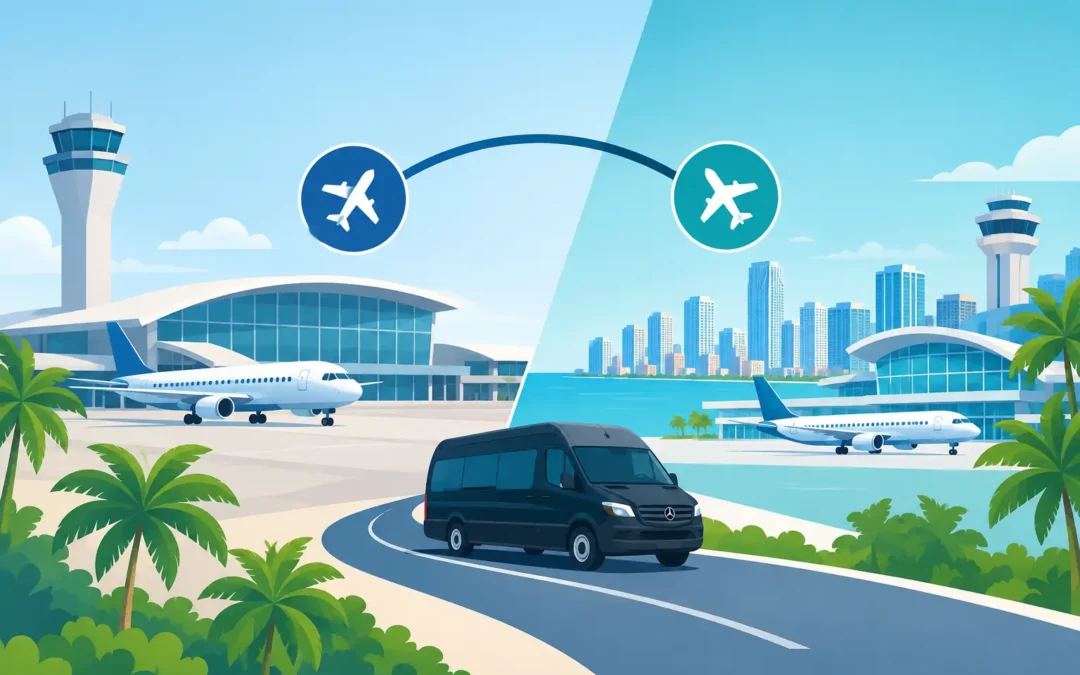
A FLL vs MIA transfer can look simple on a map, yet it is one of the South Florida rides where details matter most. A delayed arrival, checked luggage, a cruise departure, or a meeting on Brickell Avenue can turn a 30-mile airport transfer into a tight timeline. The right transportation plan gives you room to travel comfortably, stay on schedule, and arrive prepared.
Fort Lauderdale-Hollywood International Airport and Miami International Airport serve overlapping markets, but they are not interchangeable once your itinerary is set. Whether you are connecting between airports, arriving at one and staying near the other, or coordinating transportation for clients, understanding the route helps you make a better reservation.
How Long Does an FLL vs MIA Transfer Take?
The distance between FLL and MIA is generally about 30 miles, depending on the exact terminal, hotel, private terminal, port, or final destination. In light traffic, the drive may take roughly 35 to 45 minutes. In typical daytime traffic, plan closer to 50 to 75 minutes. During rush hour, major events, holiday weekends, or severe weather, travel can take longer.
South Florida traffic does not follow a single predictable pattern. Morning and late-afternoon commuter traffic can affect I-95 and other primary routes, while conventions, concerts, sporting events, cruise activity, and airport construction may change conditions quickly. A transfer that is comfortable with a two-hour window may feel risky with only 45 minutes between a scheduled landing and an onward flight.
For airport-to-airport connections, the transfer time is only one part of the equation. You also need to account for deplaning, baggage claim, customs and immigration when applicable, terminal changes, airline check-in deadlines, and security screening at the departing airport. Travelers with an international departure or checked bags should allow meaningful extra time rather than planning around the fastest possible drive.
Choosing the Right Airport Transfer Vehicle
The best vehicle for an FLL vs MIA transfer depends on more than passenger count. Luggage volume, travel purpose, comfort expectations, and whether you need to work en route all influence the right choice.
An executive sedan is well suited to one or two travelers with standard luggage who want a quiet, refined ride between airports, a hotel, or a business appointment. A luxury SUV offers additional space and is often the stronger choice for families, executives traveling with equipment, or passengers with multiple large bags. For groups, vans and Sprinter vehicles provide room for travelers and luggage without requiring the party to split between multiple cars.
For corporate delegations, wedding parties, cruise groups, and event guests, a mini coach or bus can simplify coordination. One organized pickup can be more efficient than tracking several rides, especially when flights arrive at different times or the group needs to reach a hotel, venue, or port on a set schedule.
Premium transportation is also about the condition of the vehicle and the service around it. A clean, well-presented vehicle, a professional chauffeur, and enough room to settle in after a flight make a notable difference when the ride is an hour or more.
When Private Transportation Makes the Most Sense
Shared shuttles and on-demand rides may work for travelers with flexible schedules and minimal luggage. They can also introduce uncertainty: multiple stops, changing pickup instructions, surge pricing, limited vehicle availability, and drivers who may not be familiar with commercial airport procedures.
A reserved private transfer is especially valuable when timing and presentation matter. Business travelers can use the ride to prepare for a meeting or decompress after a flight. Families avoid moving children, car seats, and luggage through several pickup areas. Private aviation guests and their coordinators can arrange transportation that reflects the discretion and punctuality expected around FBO travel.
A chauffeur-led reservation also provides a clear point of accountability. Rather than searching for a vehicle after landing, passengers have a confirmed service plan. Flight tracking allows the pickup schedule to be adjusted around changing arrival times, while a 24/7 operation is useful for early departures, late arrivals, and itinerary changes outside regular business hours.
FLL vs MIA Transfer Planning for Connecting Flights
A connection between FLL and MIA should be treated as a ground transfer, not as a quick terminal change. These are separate airports with separate check-in, security, and baggage processes. Even when flights are booked on the same day, the traveler is responsible for getting from one airport to the other with enough time to complete every required step.
If possible, avoid booking a short connection simply because the driving distance appears manageable. A delayed inbound flight can compress the schedule immediately. International arrivals can add uncertainty because immigration and baggage timing vary widely. Travelers heading to a cruise port should build in even more flexibility, since ship boarding windows are firm.
When reserving transportation, provide the arrival airline, flight number, passenger count, luggage estimate, and departure airport. If you have a flight departing from MIA, share the airline and preferred arrival time at the terminal. This allows the service provider to plan the pickup accurately and recommend a vehicle that fits the group.
Pickup Details Matter at Both Airports
Commercial airports have designated pickup zones, traffic controls, and terminal-specific procedures that can change. A professional chauffeur service coordinates the meeting process in advance, so passengers know where to go after collecting their bags. Clear communication is particularly helpful at night, during peak travel periods, or when a traveler is unfamiliar with the airport.
At FLL, travelers may arrive near the cruise port, Las Olas, Fort Lauderdale Beach, Hollywood, Plantation, Weston, or Boca Raton before continuing south. At MIA, common destinations include downtown Miami, Brickell, Miami Beach, Aventura, Sunny Isles, Coral Gables, and private aviation facilities. The pickup and drop-off locations affect both route planning and total travel time.
Beyond the Airports: Hotels, Ports, and Meetings
Many travelers searching for an FLL vs MIA transfer are not actually flying directly from one airport to the other. They may land at FLL because of a preferred flight schedule, then continue to a Miami hotel, a Brickell office, the Port of Miami, or an event venue. Others fly into MIA and need to reach Fort Lauderdale, Boca Raton, or a cruise departure.
In those situations, the transfer should be built around the entire day, not just the airport ride. An executive arriving at MIA for a presentation in Fort Lauderdale may need a vehicle that supports a composed arrival and a precise schedule. A family traveling from FLL to a Miami Beach resort may value luggage capacity, child-seat planning, and a direct ride with no additional stops. A group attending a convention may need coordinated pickups across multiple flights.
For travelers who want one dependable plan, Omni Transportation Service can arrange private airport transportation with professionally presented chauffeurs, flight monitoring, and vehicle options suited to individual travelers, families, and groups.
What to Confirm Before You Reserve
Before finalizing an airport transfer, confirm the flight details, number of travelers, luggage count, and the exact pickup and drop-off locations. If you are traveling with children, oversized items, golf clubs, presentation materials, or mobility equipment, mention it during the reservation process. These details help ensure the vehicle is appropriate from the start.
It is also wise to identify your true timing requirement. Do you need to be at the next airport by a specific time, or do you simply want to leave after landing? Is your flight domestic or international? Will you need to collect bags? A polished transportation plan accounts for the full sequence, rather than assuming that a short drive equals a short transfer.
The most comfortable airport transfer is the one that leaves nothing to chance. Reserve with enough time, choose a vehicle that fits the journey, and give your schedule the margin it deserves. Then the distance between FLL and MIA becomes a well-managed part of your trip, not the part you spend worrying about.
Recent Comments